
"The trend is your friend" is classic advice for one simple reason: trading with the trend means working with the market's dominant pressure, not against it. This chapter ties the previous lessons together into one way of looking at the market.
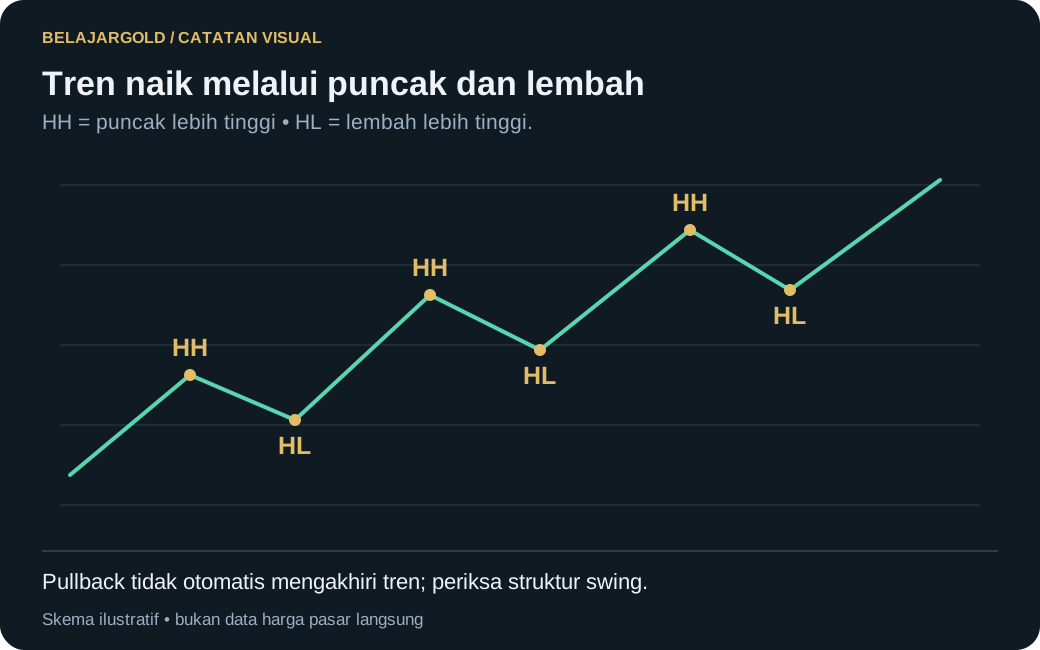
Recognizing a trend from structure
- Uptrend: a series of higher highs and higher lows. Buyers are in control.
- Downtrend: a series of lower highs and lower lows. Sellers are in control.
- Sideways / ranging: highs and lows are level. Neither side is winning — it is often better to wait.
Tools: trendlines and moving averages
A trendline is drawn connecting at least two lows (in an uptrend) or two highs (in a downtrend). Its purpose is to visualize the slope and provide a reaction area.
A moving average (for example, the 50 MA and 200 MA) is used as a direction filter: if price stays consistently above a rising MA, the bias is up; if it stays below a falling MA, the bias is down. An MA is not a standalone entry signal — it is context.
The "follow the trend" principle in practice
- Identify the trend on a higher timeframe (H4/D1). This sets the direction you are allowed to trade.
- Wait for price to pull back to an interesting area: a trendline, an MA, or a support/resistance level that has flipped roles.
- Look for a trigger in the direction of the trend on a lower timeframe (a continuation candle pattern, a minor breakout).
- Place your stop loss on the side that proves your scenario wrong — usually beyond the last swing point.
- Let the target follow the structure: the next high/low, or trail behind higher lows / lower highs.
Common mistakes when trading against the trend
- Guessing tops/bottoms. "It has gone up a lot, so it must fall" is not analysis — it is an opinion. Trends can last far longer than expected.
- Adding to losing positions (averaging down) against the direction. This increases risk precisely when the market is telling you that you are wrong.
- Treating sideways as a trend. Trend-following strategies perform poorly in flat markets; identify the condition first.
When "follow the trend" is less suitable
When the market is in a wide range, or ahead of high-impact news releases that can reverse direction instantly. In those conditions, reducing position size or not entering at all is a legitimate decision.
Key points
- Trend = the side that is currently in control. Trade on its side.
- The best entries usually come on a pullback within the trend, not after price has already run far.
- Trendlines and MAs are directional context, not buy/sell buttons.
- Trading against the trend requires very strong reasons and much smaller risk.
Disclaimer risiko: seluruh konten di situs ini disediakan untuk tujuan edukasi, bukan nasihat keuangan, sinyal, ajakan transaksi, atau janji keuntungan. Trading memiliki risiko tinggi dan dapat menyebabkan kehilangan sebagian atau seluruh modal. Pelajari legalitas penyedia layanan sesuai yurisdiksi Anda.